Mana Obscura

Menu
  • Home
  • Guides
    • Site Guide
  • About
    • About Us
    • About the Author
    • My Characters
    • What I’m Playing
  • Contact
Menu

Path of Fire – the Hopeful Skeptic

Posted on August 8, 2017 by Gazimoff

Guild Wars 2: Path of Fire

I am not good at Guild Wars 2. My experience began during the original beta, where I died so many times in the Ascalonian Catacombs instance that I polished the floor with my corpse. From such a promising start, I progressed to mediocre, gradually nurturing an Engineer and a Guardian to level cap. I avoided dungeons and feared Fractals, but I explored the world of Tyria and was happy. The dynamic events and personal story were more than enough for me.

Then came Heart of Thorns, and with it, the return of my failure cascade. The new zones, with their new enemies, were relentlessly punishing. In my mixture of looted and crafted armour, I struggled to survive. For a while I persisted while everyone else moved on, but eventually I conceded defeat. The difficulty bar had been raised, and I had been found wanting.

It’s a source of sadness, as I desperately wanted to love the game. The art style is still breathtaking several years on, but it’s the story behind Guild Wars 2 that really grabbed me. Through the Living World seasons, it’s clear that the writers behind the lore are passionate about delivering an evolving experience. Plus, the Asura are awesome – I still have a small golem on my desk.

Which is why, with the announcement of a new expansion, I’m both hopeful and skeptical in equal measure. Path of Fire promises a return to exploration and content, two topics that are high on my wishlist. It also aims to support returning players by keeping new systems to a minimum, reusing the capabilities established in Heart of Thorns. But, beyond those well-publicised bullet-points, there’s little meaningful meat to describe what that returning experience will feel like.

Continue reading “Path of Fire – the Hopeful Skeptic”

Developer Interaction By Design

Posted on December 29, 2016 by Gazimoff

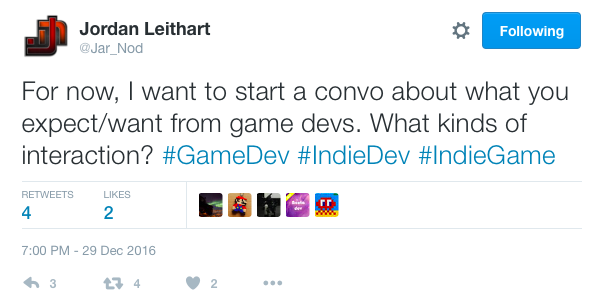
I’ll start with a disclaimer: although we’ve never met in person, I’ve known Leithart since 2012 when we were both fans of the then-upcoming MMO WildStar. Since those early days, he went into game development (coincidentally for the studio behind that same game), and I moved into game journalism. We still ping each other tweets from time to time, but that’s about it.

Getting on to the meat of the article, I wanted to respond to Leithart’s question above. As a small indie studio, with limited resources for marketing and PR, it’s only logical for the development team to want to do some of the heavy lifting themselves. It drums up interest in the game, provides direct feedback from potential players, and removes any reliance on the fickle foibles of the gaming press. Sounds like a win-win for spending a few minutes on Twitter, right?

Only, not really. While I’m a big fan of developers interacting with fans on social media, producing blog posts about their work and sharing unique insight, there’s also a risk that it gets in the way of actually developing the game. Tangentially, there’s also a risk that the game’s marketing voice – how it wants to be perceived by the gaming public – can get fragmented and/or diluted. And what happens if one of the developers goes off-brand? Can the incident be isolated without contaminating the game’s brand as a whole?

So, with both of these in mind, answering Leithart’s question is going to be tricky, particularly as I’m eager to make sure that both gamers and developers get something from being on social media. Luckily, there’s a bit of a cheat-sheet.

Continue reading “Developer Interaction By Design”

Warcraft: Legion – Endgame Perfected?

Posted on September 23, 2016 by Gazimoff

wowscrnshot_091816_141613With a few notable exceptions, levelling in MMOs is a temporary experience. We get a few weeks of meaty questing and cinematics, followed by months of waiting for content updates. It’s the Achilles Heel of the theme-park experience – rich and deep while it lasts, but bland and repetitive once the cap is reached.

I’ve made no secret about how much I was put off Mists of Pandaria, seeing a small forest of exclamation marks to mark the daily quest hub, as if to signify where I’d be spending the rest of the expansion. Warlords of Draenor tried to mix it up with the Garrison experiment, but it left me feeling less like a hero and more like a middle manager.

Which is why I’m surprised with how I feel about Legion. Sure, there’s an element of nostalgia here, as familiar NPCs play out a story that feels more like a main event than a timeline-based distraction. But it’s also been – and continues to be – hugely enjoyable to play, and that includes the time I’ve spent dancing around at cap.

How has Legion pulled off this magic trick? Looking deeper, I think there’s a clever blend of design choices at work, all acting together to make that endgame experience as frictionless and immersive as possible.

Continue reading “Warcraft: Legion – Endgame Perfected?”

The Legion Dungeon Love-Affair

Posted on September 8, 2016 by Gazimoff

‘Thank you for fetching my tools, Wilkins. But, before I can teach you the secrets of Mid-Legion Tailoring, you must carry out one more task’

‘Yes, Master?’ The scruffy young apprentice looked up, hope welling in his big eyes.

‘Indeed. You see, we have run out of Milk. I’ve heard tales of the Naga breeding incredible cows, and I long to sample their produce within my precious Sin’dorei tea. You must travel into the Eye of Azshara, defeat the Naga, milk one of these cows and bring a pitcher back to me. Only then, will I feel refreshed enough to share such intricate work with you.’

The elderly figure, a stick draped in expensive robes, shared a wide, almost predatory smile.

‘But… but that’s Hero work!’

‘No buts, Wilkins. Now go, and don’t return without my Milk!’

By now, most of us have been chewing through Warcraft: Legion for a few weeks. On the whole, it represents a fantastic return to form for the ageing MMO, with a renewed focus on telling an immersive story and shrouding characters in a rich fantasy. It’s a formula that seems to have worked, with over 3.3 million copies sold and more players returning than ever before.

But, while most design updates have been enthusiastically received, one particular facet has come under increased scrutiny – the abundance of dungeon quests to gate content. If you want to complete your Order Hall missions, or even max out your Professions, expect to spend some intense combat time with four other people.

Continue reading “The Legion Dungeon Love-Affair”

Crowdsourcing MMO Design

Posted on March 19, 2016 by Gazimoff

tumblr_nvv21jsEKh1rtv2mbo2_500

Today, I’m going to look at two related topics. The first came out of a new initiative from Carbine Studios called DevConnect, where the studio asks players for input on potential changes to WildStar. The first topic is about faction barriers – a subject that had grabbed my attention following Liore’s blogpost on it earlier this week.

Personally, I’m very pleased and encouraged to see Carbine open up in this way. It harks back to early days of WildStar’s development, where topics were shared and discussed amongst a curious and growing fanbase. WildStar Uplink, as it was known back then, led to one of my first blogposts about the upcoming MMO.

As for the second subject, that’s more about the current trend for studios to solicit feedback from players to help shape and mould the future of a game, and some of the interesting new mechanisms for doing so. While forums and social media might be a community’s bread-and butter, it feels as though studios would benefit hugely from an additional tool to call upon.

Continue reading “Crowdsourcing MMO Design”

Why VR Matters to Me

Posted on March 17, 2016 by Gazimoff

Oculus-Rift-8

Not long ago, I was asked about my thoughts on virtual reality. I’d played EVE: Valkyrie, Elite: Dangerous, and Star Citizen on my Rift DK2, and I was sent a couple of questions. One of them asked if VR actually added anything to the experience, over and above playing them with a standard display. As I grappled with this, I realised there was much more to it than a simple yes/no, or even a ten-words-or-less. Allow me to explain…

Why do we play games? One theory is based around escapism – picturing ourselves as heroes on a fantastical journey, acting out scenarios completely divorced from our daily lives. Beyond books or film, a good game embeds us in the story, shrouding us in an experience where our imagination is encouraged to fill in the gaps. From what I’ve seen and experienced, virtual reality is an extension of this, making that experience – that fantasy – all the more potent.

But what if one person’s fantasy is another’s real-life?

Back in 2004, I collapsed at work. I remember how I felt; I kept swallowing, as if I was trapped on an airplane and couldn’t balance my ears. A high-pitched whine echoed around my skull, and a slow whooshing noise gradually built up, like a washing machine on the slow cycle. I broke out in a cold sweat.

Then, my vision started to break. I couldn’t focus on my laptop screen any more – my eyes seemed to be stuck rolling to the right. All the time, the noises got louder and the pressure grew. I felt like I was going to break.

And then, something gave. I slid off my chair and slumped on the floor. I don’t remember much of what happened next – apparently, I threw up in a bin. All I remember was waking up in the ambulance. Mask, blue lights, sirens, the works. Eyes still broken, so I closed them again. At the hospital, doctors struggled to find a cause; was it diabetes, or could it be epilepsy? But after describing the symptoms, I was diagnosed with Ménière’s disease.

Now, there are some cruddy sides to this: I’m prone to attacks without much warning (although I take medication to control it), and I’ve suffered hearing loss (with a risk of going deaf in later life). That aside, I’m also someone who is barred from driving. I’ll never know the freedom of going on a weekend tour down country lanes, or going on a road trip to unknown places. You see, what might be an impulsive whim to some is a fantasy that remains out of reach to me. Always a passenger, never a pilot.

Which is why virtual reality, and games like EVE: Valkyrie, are tremendously important to me. For a moment in my broken existence, I have that freedom to hit the road, or reach for the stars. I choose the heading, I gun the throttle. It is the closest I’ll ever get to being in control of a vehicle, without putting myself or others in danger. And even better, I can be the hero while doing so – I can be part of the team, learn from others, and be cheered. It sounds so simple it’s almost infantile, but that doesn’t reduce the potency of the dream.

This might be why I’m exuberant when I talk about VR games that I’ve played, as every single one is a new experience that I cannot relate to anything else. It means that I view the headset as some kind of magical device, instead of just a tool that allows me to drive a virtual car instead of a real one.

It’s also why the dismissive attitude around VR also cuts and stings more than it should. When people who have never tried the new generation of headsets start pontificating about how it’s a blind development alley that leads nowhere, it frustrates me. Here is a device which has given me experiences that others take for granted, and yet some want to snatch it away. You can’t have that. It’s a dumb idea, and it will never catch on.

I don’t think virtual reality is without problems. GDC this week has highlighted two of them – the impact of jump scares and dangers of online harassment – that make me think it will be some time before we have the tools to build MMOs using the device. But the potential is incredible, maybe not next year but five years from now, once the technology is ubiquitous.

Ultimately though, VR represents a dream that I’m desperate to see flourish, as it has the opportunity to be life-changing for so many people. Just as communications have brought us closer, virtual reality has the potential to break down barriers that most of us don’t know exist, but that some deal with as a daily part of their lives. To me, that alone makes it worth championing.

The Changing Face of MMOs

Posted on March 16, 2016 by Gazimoff

gaz_mountdoom

Sometimes, MMO commentary feels cyclical. Back in 2014, we were musing how Blizzard’s cancellation of Titan signalled an end to the grand MMO genre. Now that Daybreak Games has shoved EverQuest Next out of a similar airlock, the same opinion is doing the rounds (although with a little less doom-mongering this time around). Some existing MMOs are continuing to hold steady, while others (like WildStar) are faltering. Meanwhile, the market feels dominated by semi-persistent quasi-MMOs, and  Eastern imports that have an established record.

This in itself is not surprising. A high-quality MMO with mass-market appeal is incredibly expensive to produce today, with budgets typically breaking $100 million. They’re also incredibly time-consuming to produce, often taking seven years or more. It’s no wonder these games look dated when they finally launch, considering the age of some of the technology.

On top of that, MMO genre veterans are some of the most fickle and divisive fans in existence. We simply can’t decide on what we want. Sandbox or theme park, PvP or PvE, directed or open-ended, instanced or open world. Each possible parameter has its cult of adherents that would willingly put anything that doesn’t measure up to fire and the sword. And woe betide any studio or publisher that slips up, as your transgressions – however minor – will always be brought up.

But here’s the flip-side: MMOs are like a second home to many of us. We sink years into these games, building friendships and lives in these digital realms. When the studio makes a design choice that shatters that world, or a publisher decides to pull the plug, of course you’re going to feel bitter about it. Now repeat that time and again over ten or fifteen years, and it’s no wonder that the genre’s created the personification of cynicism. It gets tiring to put down new roots again and again, and I honestly don’t blame people for wanting the perfect game to do it in.

Brutally, it’s unlikely that we’ll see another grand MMO, at least for now. Bill Murphy has an op-ed over at MMORPG.com, with some great insight into this changing landscape from the developer point-of-view. As Syp points out over at Bio Break, we’re likely in a contracting phase, where publishers avoid investing in the genre. The next wave of MMOs is likely to be from small, independent studios that focus on a particular niche aspect – titles like Crowfall (disclaimer: I backed the Kickstarter), Camelot Unchained and so on. Ardwulf makes a point on this – the advent of Unity 5 is helping studios to do the heavy lifting on the engine front, allowing them to focus on mechanics, systems and settings. The same is true of the Unreal Engine, powering small shooters and survival sandboxes alike. Where the infamous Hero Engine failed, others are picking up the slack.

So, where next? As Syl at MMO Gypsy put it, MMOs are here to stay, although the form that they take might well be different. They’ll certainly be smaller in size and scope, requiring less investment, fewer people and a shorter time to build – much like how EVE Online and Runescape started some fifteen years ago. The kind of games that start out small, but could grow to build a legacy.

I also think that battlegrounds and arenas will vanish as an aspect of MMOs. Over the next year we’ve got Gigantic, Battleborn, Paragon, and Overwatch, all fighting it out to become the next big competitive brawler. With all these offering to scratch a similar itch, is it worth trying to build that inside of an MMO, complete with all the inherent arguments about balance, seasons, and gear issues?

Radically, I think that the future may involve the player taking more control than ever before. Much as we used to run Quake servers in days gone by, and Minecraft servers more recently, I think we’ll start to see MMOs adopt some form of roll-your-own server. Don’t like the rules set in Ark: Survival Evolved? Rent one for a few dollars, and choose your own. It’s not that far-fetched to see this evolve into a hub-and-spoke model, using a central area to congregate with other players, and your own back yard to mess around with as you want.

So there you have it. The future of MMO gaming: tightly controlled and regulated PvP arenas on the one hand; quasi-MMOs that build persistent online experiences to established game types on the other; and fragmented, diverse, small-scale and experimental online experiences in the third, gripping hand. Nothing grand for a good ten years, unless it rises up from the small stuff organically. And huge community involvement, from building your own pocket dimensions, to designing new costumes, weapons, and more besides.

Cynical? Pah. I’m too old to be cynical.


The Stardew Valley Fallacy

Posted on March 7, 2016 by Gazimoff

StardewValley_9

Recently, I’ve been playing Stardew Valley a lot. It’s a charming retro game, featuring a young hero who shuns being a corporate slave, trading it for a new life on his grandfather’s farm. But it’s not just about growing crops and tending animals; there’s a little bit of adventuring on the side, and the entire game is overlaid with this social aspect of helping the townsfolk and rejuvenating the village.

Part of the success of Stardew Valley is that it’s a stark contrast to what most of us are currently playing. The 8-bit art style and gameplay is evocative of Harvest Moon, a franchise that’s still yet to make it to PC, and uncorking a significant amount of bottled-up nostalgia. The slower pace also flies in the face of immediacy-driven or constant-trickle rewarding, with both crops and friendships taking time to nurture and grow. While Stardew Valley isn’t groundbreaking, it represents time well spent, which is all most of us are after at the pocket-money Steam price.

That ‘of-the-moment’-ness is also evocative of a less favourable time in online gaming. With Mists of Pandaria, it seemed as though Blizzard were cramming in similar gameplay to World of Warcraft, where we’d get an old farm and start building it up. The concept was added to in Warlords of Draenor, as we got our own garrison of minions to do our bidding. It felt as if the studio was trying to offer two-speed gameplay – dunegoneering for immediate reward, alongside being an armour-plated middle manager for longer-term gains.

Trouble is, what happens when those dungeons and raids start to feel old and stale, or no longer offer rewards? My own experience was a gradually shrinking gameplay session, where I’d log in, do stuff around my garrison, collect loot from my minions and send them out on missions again. It became a daily checklist – I wasn’t being a hero any more, but just  a supervisor on the factory floor. That’s not an adventure, it’s a job. Just add in some commuting mini-game, and you’ve got a regular nine-to-five compressed to half an hour of mouse clicks.

It also nuked the social aspect of online gaming. After all, why go to the big city when you have everything you need at home, all carefully optimised thanks to some guide you found? I didn’t see my gaming buddies any more. I no longer felt the need to stir things up in Stormwind. I didn’t randomly role-play any more. And, in the end, I stopped logging in. That, and the entirety of WoD felt like a self-indulgent diversion from the actual plot.

Now, I’m not saying that Blizzard can’t learn from previous expansions. My experience with the Legion alpha so far is almost like comparing chalk and cheese, and I’m enjoying it immensely. The subtle move to class order halls is also interesting, as it means you’re more likely to bump into other players while going through your game session cycle. Those  order halls will also have follower missions, and here’s where the cynicism creeps in. There’s a tremendous opposition to the existing WoD garrison format – of being a taskmaster rather than an adventurer – and it’s an opposition that I definitely share.

In Legion, the word is that we’ll still send our followers on missions, but that we’ll also lead them on those adventures instead of sitting back at the ranch awaiting their return. That said, follower missions haven’t been added to the current alpha yet, so there’s an element of the unknown here.

Anyhow, back to my point. When designing an MMO, there’s clearly a desire to look at other games that have high player adhesion and no real end-state. Management games like The Sims and Stardew Valley are one. Idle games like Adventure Capitalists are another. But if those games don’t gel with the core experience – of being the hero and going on epic adventures – then players are legitimately going to question why you’ve added them. And if those diversions start to replace those core experiences, so a player’s entire game cycle is taken up with non-core stuff, don’t be surprised if they go searching for heroic adventure elsewhere.

I’m more confident than normal that Blizzard knows this, as there’s been a lot of talk about bringing out the various fantasies, and making the classes and specs feel more heroic and true to type. This focus on different ways in which players can be heroic is a great thing, and it’s something I hope has been osmosed into other design teams. Give us different viewpoints of the heroic fantasy, instead of trying to climb the corporate ladder at Adventure, Inc.

Stardew Valley is quite happy being Stardew Valley.  WoW doesn’t need to be every game under the sun – it just needs to be great at playing out that fantasy of being a hero on an epic adventure with friends. Sounds simple, right?

WildStar: Seeking an Artist

Posted on January 23, 2016 by Gazimoff

Joven_Nebulous.150531.205314Over countless years spent playing MMOs, I’ve explored scores of fantastical virtual worlds, seen incredible creativity manifested in breathtaking beauty, and taken part in some legendary stories. Fortunately though, I’ve not been a solo adventurer, left to wander the wilderness alone; at each step in the journey, I’ve shared these experiences with an amazing person, who became so much more than a girlfriend, fiancée, and wife. In time, we’ve created and collected a fond assortment of memories from our time gaming together.

There’s the moment we entered the great city of Tazoon in Istaria, walking for an age along deserted roads to reach a vast metropolis so full of life that our computers ground to a halt. Or the occasion when, after weeks of preparation, we descended into the cavernous Molten Core on Azeroth for the first time, and faced the toughest challenges we’d ever encountered. Or the calm we felt on the ice planet of Ilum, looking up at the dark sky and watching the galaxy slowly turn around us. More recently, on the island of ARK, we went hunting for dinosaurs to tame, watching over their sleeping bodies night and day in case something rushed us from the jungle.

Joven_Nebulous.150531.172813

Each one of these is a bubbled moment, a precious keepsake. But, beyond our shared memories and screenshots, there’s little to remind us of the time we’ve spent together. Sure, we’ve accumulated trinkets and toys from the games we’ve loved, but these don’t really describe the time we’ve spent together.

That’s why, with WildStar, we’d like to try something different. We’d like to commission an artist, and work with them to produce a piece of artwork that captures both the spirit of the game, and what we’ve gained from our time playing it. It would be of two characters (Joven Nebulous and Aurelia Valesran), and their pet Dagun, but further details such as clothing and location haven’t yet been decided.

Joven_Nebulous.150614.144943

And the eventual goal? To have it printed professionally, framed, and hung on the wall in our home. The world of Nexus is a cherished place to us, and we’d like to create something a little more permanent to remember our time together. It might take a bit of time, but we feel the result will be worth the effort, and we’re keen to collaborate with whoever we end up choosing to get there.

Importantly, we’re interested in paying the going rate for this type of commission. We both understand that it will take a significant chunk of time to produce what we’re asking for, and we’re happy to invest in a piece that works for us. But likewise, we’d prefer artists with a track record of creating this kind of work, as we’ve been burned a few times and would like a degree of confidence before parting with real cash.

Joven.140803.155647

Interested? Throw me an email at ‘me [at] gazimoff.com’, including details of your rates, timescales, and a link to previous completed commissions that you feel are relevant. Also include any questions you might have, and any other information you feel is relevant. We’ll review them, and promise to get back to everyone who contacts us. And, if you know someone who might be interested, please forward this to them.

Thank you, and best of luck. With your help, we’ll be able to make a lasting legacy of our time in WildStar. And who knows – maybe it’ll be your artwork that we choose for our home.

Joven_Nebulous.150620.184117

WildStar Free-to-Play Competition – The Winners!

Posted on October 14, 2015 by Gazimoff

Wow, that was hard. My recent WildStar competition earned a flurry of responses, both in the comments and by email. And so many of them were very, very good – it made choosing winners very difficult. But winners had to be chosen, and so here they are.

First Place – OxTube

I said that submissions could be in almost any form, but I wasn’t expecting a good quality video. And the tip – about timing interrupts to get that moment of opportunity – is very, very WildStar.

https://www.youtube.com/watch?v=ZsChyfObBt4

Second Place – Themos

WildStar, unlike many MMOs, embraces the ability for players to socialise. There’s guilds and circles to form more permanent bonds, ship hands and expeditions for flexible groups, and even open-world combat encourages teaming-up. But, beyond that, it’s the close-knit megaserver-focused community that deserves special mention:

This is my ultimate tip for every player of Wildstar: Socialize :D. Yes, simple as that. It may sound a bit dumb but that’s how you will get hooked on Wildstar. Many mmos have great combat, challenging encounters, awesome graphics and many players to play with.. but only Wildstar has such a kind and gracious community. Whatever problems you might have, Nexus citizens will always be there to help. They will guide you, they will help you become stronger, they will give you tips for surviving on this dangerous planet and best of all.. you will have fun playing with them. So as soon as you step your foot on Nexus, don’t hesitate to talk to others or ask for advice. (As for me I made some awesome friends on Nexus.. and thanks to them I am enjoying this great game more than ever). So that’s my tip. Go out there and communicate with others! Nexus is a dangerous place for solitary adventurers after all.

Third Place – Xokako

No other MMO has combat quite like WildStar’s, and it takes some getting used to. Even more vital is understanding how it works, and how ability and AMP choices have an impact. Following a guide can give a quick shortcut, but there’s no substitute for that precious knowledge:

My advice to everyone with or without experience is not to blindly follow a rotation/priority system because you saw it in a guide. Don’t get me wrong it’s good that you read up and search for others opinion, but test it always and be brave to experiment. I’ve been lucky enough to get on a guild with players with such mentality and over all my MMO experience this is by far the most fun I’ve been having, from discussing the build, to test and compare it on dozens of parses.

Fourth Place – Allarius

This doesn’t just apply to runecrafting, but to almost all crafting professions (particularly tailors). If you’re not going to use something, salvage it. Save vendor trash for junk that can’t be broken down into something useful.

Savlage everything. Don’t sell any piece of gear you get just salvage. You will thank me when you start runing your gear.

Thanks again to everyone who took part. Fingers crossed, I’ll be running more competitions again soon!

  • Previous
  • 1
  • 2
  • 3
  • 4
  • 5
  • 6
  • …
  • 32
  • Next

Recent Posts

  • Discovering Palia
  • WildStar: The End
  • Final Fantasy XIV: Heavensward – The Latecomer Review
  • Blizzard Engineering – The Nuggets from Blizzcon 2018
  • Final Fantasy XIV: A Realm Reborn – The Latecomer Review

Recent Comments

  1. Wanderhoof on Final Fantasy XIV: A Realm Reborn – The Latecomer Review
  2. f2h on Final Fantasy XIV: A Realm Reborn – The Latecomer Review
  3. Peter Parker on Final Fantasy XIV: A Realm Reborn – The Latecomer Review
  4. Ami on Final Fantasy XIV: A Realm Reborn – The Latecomer Review
  5. Slesliat on Final Fantasy XIV: A Realm Reborn – The Latecomer Review

Archives

  • June 2021
  • November 2018
  • February 2018
  • January 2018
  • December 2017
  • November 2017
  • October 2017
  • August 2017
  • December 2016
  • September 2016
  • March 2016
  • January 2016
  • October 2015
  • September 2015
  • March 2015
  • October 2014
  • September 2014
  • August 2014
  • June 2014
  • February 2014
  • November 2013
  • October 2013
  • September 2013
  • August 2013
  • May 2013
  • November 2012
  • August 2012
  • July 2012
  • June 2012
  • May 2012
  • April 2012
  • March 2012
  • February 2012
  • January 2012
  • December 2011
  • November 2011
  • October 2011
  • September 2011
  • August 2011
  • July 2011
  • June 2011
  • May 2011
  • April 2011
  • March 2011
  • February 2011
  • January 2011
  • December 2010
  • November 2010
  • October 2010
  • September 2010
  • August 2010
  • July 2010
  • June 2010
  • May 2010
  • April 2010
  • March 2010

Categories

  • Final Fantasy XIV
  • General Gaming
  • Guest Posts
  • Guild Wars 2
  • Mage Mumblings
  • MMO Musings
  • Site Stuff
  • Star Wars: The Old Republic
  • Uncategorized
  • Warcraft
  • WildStar
© 2026 Mana Obscura | Powered by Minimalist Blog WordPress Theme