Mana Obscura

Menu
  • Home
  • Guides
    • Site Guide
  • About
    • About Us
    • About the Author
    • My Characters
    • What I’m Playing
  • Contact
Menu

Category: MMO Musings

Crowdsourcing MMO Design

Posted on March 19, 2016 by Gazimoff

tumblr_nvv21jsEKh1rtv2mbo2_500

Today, I’m going to look at two related topics. The first came out of a new initiative from Carbine Studios called DevConnect, where the studio asks players for input on potential changes to WildStar. The first topic is about faction barriers – a subject that had grabbed my attention following Liore’s blogpost on it earlier this week.

Personally, I’m very pleased and encouraged to see Carbine open up in this way. It harks back to early days of WildStar’s development, where topics were shared and discussed amongst a curious and growing fanbase. WildStar Uplink, as it was known back then, led to one of my first blogposts about the upcoming MMO.

As for the second subject, that’s more about the current trend for studios to solicit feedback from players to help shape and mould the future of a game, and some of the interesting new mechanisms for doing so. While forums and social media might be a community’s bread-and butter, it feels as though studios would benefit hugely from an additional tool to call upon.

Continue reading “Crowdsourcing MMO Design”

Why VR Matters to Me

Posted on March 17, 2016 by Gazimoff

Oculus-Rift-8

Not long ago, I was asked about my thoughts on virtual reality. I’d played EVE: Valkyrie, Elite: Dangerous, and Star Citizen on my Rift DK2, and I was sent a couple of questions. One of them asked if VR actually added anything to the experience, over and above playing them with a standard display. As I grappled with this, I realised there was much more to it than a simple yes/no, or even a ten-words-or-less. Allow me to explain…

Why do we play games? One theory is based around escapism – picturing ourselves as heroes on a fantastical journey, acting out scenarios completely divorced from our daily lives. Beyond books or film, a good game embeds us in the story, shrouding us in an experience where our imagination is encouraged to fill in the gaps. From what I’ve seen and experienced, virtual reality is an extension of this, making that experience – that fantasy – all the more potent.

But what if one person’s fantasy is another’s real-life?

Back in 2004, I collapsed at work. I remember how I felt; I kept swallowing, as if I was trapped on an airplane and couldn’t balance my ears. A high-pitched whine echoed around my skull, and a slow whooshing noise gradually built up, like a washing machine on the slow cycle. I broke out in a cold sweat.

Then, my vision started to break. I couldn’t focus on my laptop screen any more – my eyes seemed to be stuck rolling to the right. All the time, the noises got louder and the pressure grew. I felt like I was going to break.

And then, something gave. I slid off my chair and slumped on the floor. I don’t remember much of what happened next – apparently, I threw up in a bin. All I remember was waking up in the ambulance. Mask, blue lights, sirens, the works. Eyes still broken, so I closed them again. At the hospital, doctors struggled to find a cause; was it diabetes, or could it be epilepsy? But after describing the symptoms, I was diagnosed with Ménière’s disease.

Now, there are some cruddy sides to this: I’m prone to attacks without much warning (although I take medication to control it), and I’ve suffered hearing loss (with a risk of going deaf in later life). That aside, I’m also someone who is barred from driving. I’ll never know the freedom of going on a weekend tour down country lanes, or going on a road trip to unknown places. You see, what might be an impulsive whim to some is a fantasy that remains out of reach to me. Always a passenger, never a pilot.

Which is why virtual reality, and games like EVE: Valkyrie, are tremendously important to me. For a moment in my broken existence, I have that freedom to hit the road, or reach for the stars. I choose the heading, I gun the throttle. It is the closest I’ll ever get to being in control of a vehicle, without putting myself or others in danger. And even better, I can be the hero while doing so – I can be part of the team, learn from others, and be cheered. It sounds so simple it’s almost infantile, but that doesn’t reduce the potency of the dream.

This might be why I’m exuberant when I talk about VR games that I’ve played, as every single one is a new experience that I cannot relate to anything else. It means that I view the headset as some kind of magical device, instead of just a tool that allows me to drive a virtual car instead of a real one.

It’s also why the dismissive attitude around VR also cuts and stings more than it should. When people who have never tried the new generation of headsets start pontificating about how it’s a blind development alley that leads nowhere, it frustrates me. Here is a device which has given me experiences that others take for granted, and yet some want to snatch it away. You can’t have that. It’s a dumb idea, and it will never catch on.

I don’t think virtual reality is without problems. GDC this week has highlighted two of them – the impact of jump scares and dangers of online harassment – that make me think it will be some time before we have the tools to build MMOs using the device. But the potential is incredible, maybe not next year but five years from now, once the technology is ubiquitous.

Ultimately though, VR represents a dream that I’m desperate to see flourish, as it has the opportunity to be life-changing for so many people. Just as communications have brought us closer, virtual reality has the potential to break down barriers that most of us don’t know exist, but that some deal with as a daily part of their lives. To me, that alone makes it worth championing.
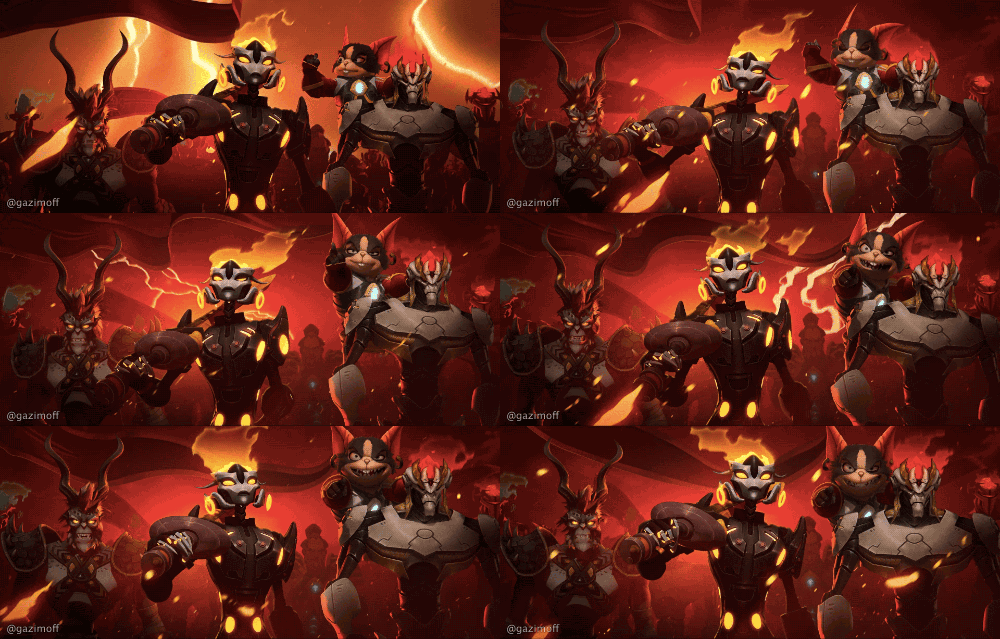
The Changing Face of MMOs

Posted on March 16, 2016 by Gazimoff

gaz_mountdoom

Sometimes, MMO commentary feels cyclical. Back in 2014, we were musing how Blizzard’s cancellation of Titan signalled an end to the grand MMO genre. Now that Daybreak Games has shoved EverQuest Next out of a similar airlock, the same opinion is doing the rounds (although with a little less doom-mongering this time around). Some existing MMOs are continuing to hold steady, while others (like WildStar) are faltering. Meanwhile, the market feels dominated by semi-persistent quasi-MMOs, and  Eastern imports that have an established record.

This in itself is not surprising. A high-quality MMO with mass-market appeal is incredibly expensive to produce today, with budgets typically breaking $100 million. They’re also incredibly time-consuming to produce, often taking seven years or more. It’s no wonder these games look dated when they finally launch, considering the age of some of the technology.

On top of that, MMO genre veterans are some of the most fickle and divisive fans in existence. We simply can’t decide on what we want. Sandbox or theme park, PvP or PvE, directed or open-ended, instanced or open world. Each possible parameter has its cult of adherents that would willingly put anything that doesn’t measure up to fire and the sword. And woe betide any studio or publisher that slips up, as your transgressions – however minor – will always be brought up.

But here’s the flip-side: MMOs are like a second home to many of us. We sink years into these games, building friendships and lives in these digital realms. When the studio makes a design choice that shatters that world, or a publisher decides to pull the plug, of course you’re going to feel bitter about it. Now repeat that time and again over ten or fifteen years, and it’s no wonder that the genre’s created the personification of cynicism. It gets tiring to put down new roots again and again, and I honestly don’t blame people for wanting the perfect game to do it in.

Brutally, it’s unlikely that we’ll see another grand MMO, at least for now. Bill Murphy has an op-ed over at MMORPG.com, with some great insight into this changing landscape from the developer point-of-view. As Syp points out over at Bio Break, we’re likely in a contracting phase, where publishers avoid investing in the genre. The next wave of MMOs is likely to be from small, independent studios that focus on a particular niche aspect – titles like Crowfall (disclaimer: I backed the Kickstarter), Camelot Unchained and so on. Ardwulf makes a point on this – the advent of Unity 5 is helping studios to do the heavy lifting on the engine front, allowing them to focus on mechanics, systems and settings. The same is true of the Unreal Engine, powering small shooters and survival sandboxes alike. Where the infamous Hero Engine failed, others are picking up the slack.

So, where next? As Syl at MMO Gypsy put it, MMOs are here to stay, although the form that they take might well be different. They’ll certainly be smaller in size and scope, requiring less investment, fewer people and a shorter time to build – much like how EVE Online and Runescape started some fifteen years ago. The kind of games that start out small, but could grow to build a legacy.

I also think that battlegrounds and arenas will vanish as an aspect of MMOs. Over the next year we’ve got Gigantic, Battleborn, Paragon, and Overwatch, all fighting it out to become the next big competitive brawler. With all these offering to scratch a similar itch, is it worth trying to build that inside of an MMO, complete with all the inherent arguments about balance, seasons, and gear issues?

Radically, I think that the future may involve the player taking more control than ever before. Much as we used to run Quake servers in days gone by, and Minecraft servers more recently, I think we’ll start to see MMOs adopt some form of roll-your-own server. Don’t like the rules set in Ark: Survival Evolved? Rent one for a few dollars, and choose your own. It’s not that far-fetched to see this evolve into a hub-and-spoke model, using a central area to congregate with other players, and your own back yard to mess around with as you want.

So there you have it. The future of MMO gaming: tightly controlled and regulated PvP arenas on the one hand; quasi-MMOs that build persistent online experiences to established game types on the other; and fragmented, diverse, small-scale and experimental online experiences in the third, gripping hand. Nothing grand for a good ten years, unless it rises up from the small stuff organically. And huge community involvement, from building your own pocket dimensions, to designing new costumes, weapons, and more besides.

Cynical? Pah. I’m too old to be cynical.


Death of a Super-Genre

Posted on September 23, 2014 by Gazimoff

The time of the full-fat feature-packed MMORPG is at an end. They are ridiculously expensive to produce, and are regularly met with scorn and disinterest by an increasingly cynical audience. The market has spoken very clearly – these are not the games people want to play. Blizzard’s decision to cancel Titan – an upcoming MMOFPS that didn’t have their full confidence – just goes to show how tough this is.

Publishers and developers are paying attention. Just take a look at the MMORPG release schedule for 2015 – there’s nothing for the traditional genre fan. It’s something I noticed when walking the floor at Gamescom, where all the big MMO stands were for games that had been out for months if not years. World of Warcraft, Final Fantasy XIV: A Realm Reborn, WildStar and Guild Wars 2 on the Twitch booth. But nothing new or upcoming to carry the MMO banner.

Continue reading “Death of a Super-Genre”

The High Price of Founding

Posted on September 10, 2014 by Gazimoff

I have a concern, and it’s about the high price of MMO ‘founders packs.’ For a strong title that’s still early in development, it’s a great way to raise funds and bring in eager gamers to test the game out. But the status of being an early adopter comes with a cost, and it’s usually measured in dollars. I’ve seen studios charge as much as $150 to get into the alpha of a free-to-play title.

Fundamentally, that feels wrong. With an unseen and un-previewed title, the risk for buyer’s remorse is huge. More importantly, however, I don’t think it’ll result in the right mix of testers that will hammer content hard without trying to buy their way around a problem, usually through premium currency tokens. That might be the kind of game that the studio wants to make, but my experience tells me there are better ways to persuade players to part with their cash.

The most common strategy I’ve seen used is where higher prices are charged for earlier access. Pre-alpha costs $150, alpha costs $100, closed beta is at $50, and open beta is free. The bigger packs come with more in-game items and premium currency, but little else besides. It rewards those cash-rich players that can risk that much on a game they might only play once, while hindering the cash-poor but time-rich players that would be a great testing asset.

What would I propose? Glad you asked. Basically, it’s a blend of the existing methods we already see, and the best of Kickstarter. Crucially though, it also lets players trade up – if they like what they see, they can pay more, unlock more, and get themselves a bargain. It reduces the risk on the player, but rewards the developer as well. As an example, imagine there’s a steampunk sandbox MMO called Cogsworld, and it’s just about to hit alpha. Here’s how I’d see it playing out:

  • $20 – Tourist Visa: Limited to 1000 – The Cogsworld Tourist Office only hands out a limited number of visas every year, so grab one before they run out! A stipend of 200 Platinum Cogs is included
  • $50 – Resident: Limited to 2000 – Buy a green card and the city of Cogsopolis will grant you numerous perks, including 600 Platinum Cogs to get you started.
  • $100 – Nobility – As a member of one of the Cogsworld Nobility, you are always welcome. Your inheritance of 1500 Platinum Cogs will be waiting for you at the Bank of Cogsopolis.
  • $200 – Upper Crust – Part of the Cogsworld Elite, your family has amassed a fortune of 3000 Platinum Cogs. In addition, you will be sent a real-life pennant featuring the Cogsopolis Coat of Arms, and real-world versions of the Cogsopolis currency.

All of these are just rough examples – the costs are roughly what I’d charge, but the limits and rewards are completely flexible.

On top of that, I’d allow players to buy premium currency from an item store and exchange it for regular currency on the trading post, giving those cash-poor players a way to earn extra Platinum Cogs simply by playing the game at a rate that’s set by the market itself. Finally, all currency would be reset at the end of open beta, and reassigned to the original players as part of an overall server wipe. The ability to trade would also exist in the live game.

Having this run through beta will, in itself, generate some interesting data:

  • How much/how long does each bracket play?
  • Do players from each bracket drop out/give up at similar points, or is a group more committed?
  • When do players decide to upgrade their package, and what persuaded them to do it?
  • What bracket is more involved in the community, either championing the game or providing helpful feedback?

All of this can help the development team to understand if their actions have meaningful impacts on the playerbase. For a free-to-play title that’s reliant on those with large and small wallets, it also gives them a chance to balance out reception across the spectrum.

Here’s the other thing as well: as Cogsworld edges closer to launch, the limitations on those first two packs can be dropped, but the prices increased/adjusted to the final launch packs. Essentially, players are getting a discount for joining early, rather than being charged a premium.

That said, monetization is an ongoing discussion. Is this the kind of model you’d like to see more of, or would you prefer a different form of founders pack? Maybe you’re happy with the status quo? Whatever your opinion, sound off in the comments.

Free to Play: Myth or Miracle?

Posted on October 10, 2013 by Gazimoff

It’s become almost a perennial tale: an MMO in distress makes the switch to free-to-play and becomes instantly successful. But, without hard numbers, it’s been difficult to appreciate just how much a difference it can make.

That has now changed. In a great interview with Daniel Tack at Forbes, Rift Creative Director Bill Fisher revealed some fascinating figures. It’s worth reading the entire article, but the headline number is staggering: revenue increased five times. That’s difficult for any developer to ignore.

It gives rise to a number of follow-up questions. Was the uplift a momentary surge or sustained growth? What does the average revenue per active player look like? How reliant are they on a certain subset of players? Has the change improved Rift’s long-term fortunes, or was it just a blip on the radar?

Continue reading “Free to Play: Myth or Miracle?”

Upgrade Season

Posted on October 8, 2013 by Gazimoff

w7u

Just over two years ago, I built a PC that would be able to play the ‘next generation’ of MMOs. It was a silly notion considering that, at the time, I didn’t have an idea what next generation truly meant. I just wanted to build something that would provide obscene frame rates without leaving me penniless.

It’s a strategy that worked. I’ve gone from WoW: Cataclysm, to SWTOR, to TERA, to The Secret World and Guild Wars 2, all without a hitch. I’ve managed to run them on high settings and capture stunning video. Whatever game I’ve wanted to play, my hardware hasn’t held me back.

Continue reading “Upgrade Season”

PlayStation 4: A Console for MMO Gamers?

Posted on October 3, 2013 by Gazimoff

About 5 months ago, I made the decision to preorder a PlayStation 4. Some of you might see that as a bold or brave choice, while others might think that it’s ridiculous or short-sighted. A few might even wonder why, as a heavy-PC gamer with a powerful gaming rig, I’m getting a console at all.

The truth is, I’ve been eyeing up the next generation of consoles for some time now. The graphical grunt and online capabilities of each machine feel like they’re getting good enough to deliver some incredibly rich experiences. Take one look at titles like Titanfall, Destiny, The Division and Dying Light, and it’s clear that the concept of multiplayer gaming is changing. With flexible grouping systems and an open-world feel, they’re beginning to borrow from the MMO playbook.

Continue reading “PlayStation 4: A Console for MMO Gamers?”

WildStar: The Flying Mount Frenzy

Posted on May 17, 2013 by Gazimoff

In the main, WildStar’s development is going smoothly. Led by a team of veterans who have worked on almost every MMO released, the Orange County developer hasn’t put a foot wrong. Every decision they’ve made has been warmly welcomed by an incredibly positive community.

Except there’s one decision they’re not sure about: Flying Mounts.

As Jeremy Gaffney explained to me earlier this week, the decision seemed like a no-brainer when they built the world four years ago. Now they’ve had a chance to think about it and gather feedback from the community, there doesn’t seem to be a clear way ahead. Some desperately want flying mounts, while others are dead against them.

But why? And is there a solution that can satisfy both camps?

Continue reading “WildStar: The Flying Mount Frenzy”

The Launch Day Blues

Posted on August 26, 2012 by Gazimoff

When was the last time you saw an MMO launch that went off without a hitch? From login issues preventing access, to major functions being disabled, it seems that almost every modern MMO has a rocky start in life. Even complex online games have been exposed to similar problems, from days of inaccessibility to weeks of poor performance.

But why does it happen? Why do experienced companies who are used to building and maintaining these types of systems continually run into these kinds of problems? Why are they, in many cases, unable to thoroughly test these kinds of systems. And what can be done to make sure that gamers still have a good experience, even if some features are unavailable?

I’m going to try to tackle a handful of these issues, explaining what companies can do, but why they also don’t help cater for every example. And while I have experience of designing massively multi-user systems myself, the usage patterns relating to MMO gaming are somewhat different to an online shop or customer service portal. Don’t start lambasting developers for what I write here, ‘kay?

Continue reading “The Launch Day Blues”

  • Previous
  • 1
  • 2
  • 3
  • 4
  • 5
  • 6
  • …
  • 13
  • Next

Recent Posts

  • Discovering Palia
  • WildStar: The End
  • Final Fantasy XIV: Heavensward – The Latecomer Review
  • Blizzard Engineering – The Nuggets from Blizzcon 2018
  • Final Fantasy XIV: A Realm Reborn – The Latecomer Review

Recent Comments

  1. Wanderhoof on Final Fantasy XIV: A Realm Reborn – The Latecomer Review
  2. f2h on Final Fantasy XIV: A Realm Reborn – The Latecomer Review
  3. Peter Parker on Final Fantasy XIV: A Realm Reborn – The Latecomer Review
  4. Ami on Final Fantasy XIV: A Realm Reborn – The Latecomer Review
  5. Slesliat on Final Fantasy XIV: A Realm Reborn – The Latecomer Review

Archives

  • June 2021
  • November 2018
  • February 2018
  • January 2018
  • December 2017
  • November 2017
  • October 2017
  • August 2017
  • December 2016
  • September 2016
  • March 2016
  • January 2016
  • October 2015
  • September 2015
  • March 2015
  • October 2014
  • September 2014
  • August 2014
  • June 2014
  • February 2014
  • November 2013
  • October 2013
  • September 2013
  • August 2013
  • May 2013
  • November 2012
  • August 2012
  • July 2012
  • June 2012
  • May 2012
  • April 2012
  • March 2012
  • February 2012
  • January 2012
  • December 2011
  • November 2011
  • October 2011
  • September 2011
  • August 2011
  • July 2011
  • June 2011
  • May 2011
  • April 2011
  • March 2011
  • February 2011
  • January 2011
  • December 2010
  • November 2010
  • October 2010
  • September 2010
  • August 2010
  • July 2010
  • June 2010
  • May 2010
  • April 2010
  • March 2010

Categories

  • Final Fantasy XIV
  • General Gaming
  • Guest Posts
  • Guild Wars 2
  • Mage Mumblings
  • MMO Musings
  • Site Stuff
  • Star Wars: The Old Republic
  • Uncategorized
  • Warcraft
  • WildStar
© 2026 Mana Obscura | Powered by Minimalist Blog WordPress Theme