Mana Obscura

Menu
  • Home
  • Guides
    • Site Guide
  • About
    • About Us
    • About the Author
    • My Characters
    • What I’m Playing
  • Contact
Menu

Tag: design

Warcraft: Legion – Endgame Perfected?

Posted on September 23, 2016 by Gazimoff

wowscrnshot_091816_141613With a few notable exceptions, levelling in MMOs is a temporary experience. We get a few weeks of meaty questing and cinematics, followed by months of waiting for content updates. It’s the Achilles Heel of the theme-park experience – rich and deep while it lasts, but bland and repetitive once the cap is reached.

I’ve made no secret about how much I was put off Mists of Pandaria, seeing a small forest of exclamation marks to mark the daily quest hub, as if to signify where I’d be spending the rest of the expansion. Warlords of Draenor tried to mix it up with the Garrison experiment, but it left me feeling less like a hero and more like a middle manager.

Which is why I’m surprised with how I feel about Legion. Sure, there’s an element of nostalgia here, as familiar NPCs play out a story that feels more like a main event than a timeline-based distraction. But it’s also been – and continues to be – hugely enjoyable to play, and that includes the time I’ve spent dancing around at cap.

How has Legion pulled off this magic trick? Looking deeper, I think there’s a clever blend of design choices at work, all acting together to make that endgame experience as frictionless and immersive as possible.

Continue reading “Warcraft: Legion – Endgame Perfected?”

The Legion Dungeon Love-Affair

Posted on September 8, 2016 by Gazimoff

‘Thank you for fetching my tools, Wilkins. But, before I can teach you the secrets of Mid-Legion Tailoring, you must carry out one more task’

‘Yes, Master?’ The scruffy young apprentice looked up, hope welling in his big eyes.

‘Indeed. You see, we have run out of Milk. I’ve heard tales of the Naga breeding incredible cows, and I long to sample their produce within my precious Sin’dorei tea. You must travel into the Eye of Azshara, defeat the Naga, milk one of these cows and bring a pitcher back to me. Only then, will I feel refreshed enough to share such intricate work with you.’

The elderly figure, a stick draped in expensive robes, shared a wide, almost predatory smile.

‘But… but that’s Hero work!’

‘No buts, Wilkins. Now go, and don’t return without my Milk!’

By now, most of us have been chewing through Warcraft: Legion for a few weeks. On the whole, it represents a fantastic return to form for the ageing MMO, with a renewed focus on telling an immersive story and shrouding characters in a rich fantasy. It’s a formula that seems to have worked, with over 3.3 million copies sold and more players returning than ever before.

But, while most design updates have been enthusiastically received, one particular facet has come under increased scrutiny – the abundance of dungeon quests to gate content. If you want to complete your Order Hall missions, or even max out your Professions, expect to spend some intense combat time with four other people.

Continue reading “The Legion Dungeon Love-Affair”

Crowdsourcing MMO Design

Posted on March 19, 2016 by Gazimoff

tumblr_nvv21jsEKh1rtv2mbo2_500

Today, I’m going to look at two related topics. The first came out of a new initiative from Carbine Studios called DevConnect, where the studio asks players for input on potential changes to WildStar. The first topic is about faction barriers – a subject that had grabbed my attention following Liore’s blogpost on it earlier this week.

Personally, I’m very pleased and encouraged to see Carbine open up in this way. It harks back to early days of WildStar’s development, where topics were shared and discussed amongst a curious and growing fanbase. WildStar Uplink, as it was known back then, led to one of my first blogposts about the upcoming MMO.

As for the second subject, that’s more about the current trend for studios to solicit feedback from players to help shape and mould the future of a game, and some of the interesting new mechanisms for doing so. While forums and social media might be a community’s bread-and butter, it feels as though studios would benefit hugely from an additional tool to call upon.

Continue reading “Crowdsourcing MMO Design”

The Changing Face of MMOs

Posted on March 16, 2016 by Gazimoff

gaz_mountdoom

Sometimes, MMO commentary feels cyclical. Back in 2014, we were musing how Blizzard’s cancellation of Titan signalled an end to the grand MMO genre. Now that Daybreak Games has shoved EverQuest Next out of a similar airlock, the same opinion is doing the rounds (although with a little less doom-mongering this time around). Some existing MMOs are continuing to hold steady, while others (like WildStar) are faltering. Meanwhile, the market feels dominated by semi-persistent quasi-MMOs, and  Eastern imports that have an established record.

This in itself is not surprising. A high-quality MMO with mass-market appeal is incredibly expensive to produce today, with budgets typically breaking $100 million. They’re also incredibly time-consuming to produce, often taking seven years or more. It’s no wonder these games look dated when they finally launch, considering the age of some of the technology.

On top of that, MMO genre veterans are some of the most fickle and divisive fans in existence. We simply can’t decide on what we want. Sandbox or theme park, PvP or PvE, directed or open-ended, instanced or open world. Each possible parameter has its cult of adherents that would willingly put anything that doesn’t measure up to fire and the sword. And woe betide any studio or publisher that slips up, as your transgressions – however minor – will always be brought up.

But here’s the flip-side: MMOs are like a second home to many of us. We sink years into these games, building friendships and lives in these digital realms. When the studio makes a design choice that shatters that world, or a publisher decides to pull the plug, of course you’re going to feel bitter about it. Now repeat that time and again over ten or fifteen years, and it’s no wonder that the genre’s created the personification of cynicism. It gets tiring to put down new roots again and again, and I honestly don’t blame people for wanting the perfect game to do it in.

Brutally, it’s unlikely that we’ll see another grand MMO, at least for now. Bill Murphy has an op-ed over at MMORPG.com, with some great insight into this changing landscape from the developer point-of-view. As Syp points out over at Bio Break, we’re likely in a contracting phase, where publishers avoid investing in the genre. The next wave of MMOs is likely to be from small, independent studios that focus on a particular niche aspect – titles like Crowfall (disclaimer: I backed the Kickstarter), Camelot Unchained and so on. Ardwulf makes a point on this – the advent of Unity 5 is helping studios to do the heavy lifting on the engine front, allowing them to focus on mechanics, systems and settings. The same is true of the Unreal Engine, powering small shooters and survival sandboxes alike. Where the infamous Hero Engine failed, others are picking up the slack.

So, where next? As Syl at MMO Gypsy put it, MMOs are here to stay, although the form that they take might well be different. They’ll certainly be smaller in size and scope, requiring less investment, fewer people and a shorter time to build – much like how EVE Online and Runescape started some fifteen years ago. The kind of games that start out small, but could grow to build a legacy.

I also think that battlegrounds and arenas will vanish as an aspect of MMOs. Over the next year we’ve got Gigantic, Battleborn, Paragon, and Overwatch, all fighting it out to become the next big competitive brawler. With all these offering to scratch a similar itch, is it worth trying to build that inside of an MMO, complete with all the inherent arguments about balance, seasons, and gear issues?

Radically, I think that the future may involve the player taking more control than ever before. Much as we used to run Quake servers in days gone by, and Minecraft servers more recently, I think we’ll start to see MMOs adopt some form of roll-your-own server. Don’t like the rules set in Ark: Survival Evolved? Rent one for a few dollars, and choose your own. It’s not that far-fetched to see this evolve into a hub-and-spoke model, using a central area to congregate with other players, and your own back yard to mess around with as you want.

So there you have it. The future of MMO gaming: tightly controlled and regulated PvP arenas on the one hand; quasi-MMOs that build persistent online experiences to established game types on the other; and fragmented, diverse, small-scale and experimental online experiences in the third, gripping hand. Nothing grand for a good ten years, unless it rises up from the small stuff organically. And huge community involvement, from building your own pocket dimensions, to designing new costumes, weapons, and more besides.

Cynical? Pah. I’m too old to be cynical.


The Stardew Valley Fallacy

Posted on March 7, 2016 by Gazimoff

StardewValley_9

Recently, I’ve been playing Stardew Valley a lot. It’s a charming retro game, featuring a young hero who shuns being a corporate slave, trading it for a new life on his grandfather’s farm. But it’s not just about growing crops and tending animals; there’s a little bit of adventuring on the side, and the entire game is overlaid with this social aspect of helping the townsfolk and rejuvenating the village.

Part of the success of Stardew Valley is that it’s a stark contrast to what most of us are currently playing. The 8-bit art style and gameplay is evocative of Harvest Moon, a franchise that’s still yet to make it to PC, and uncorking a significant amount of bottled-up nostalgia. The slower pace also flies in the face of immediacy-driven or constant-trickle rewarding, with both crops and friendships taking time to nurture and grow. While Stardew Valley isn’t groundbreaking, it represents time well spent, which is all most of us are after at the pocket-money Steam price.

That ‘of-the-moment’-ness is also evocative of a less favourable time in online gaming. With Mists of Pandaria, it seemed as though Blizzard were cramming in similar gameplay to World of Warcraft, where we’d get an old farm and start building it up. The concept was added to in Warlords of Draenor, as we got our own garrison of minions to do our bidding. It felt as if the studio was trying to offer two-speed gameplay – dunegoneering for immediate reward, alongside being an armour-plated middle manager for longer-term gains.

Trouble is, what happens when those dungeons and raids start to feel old and stale, or no longer offer rewards? My own experience was a gradually shrinking gameplay session, where I’d log in, do stuff around my garrison, collect loot from my minions and send them out on missions again. It became a daily checklist – I wasn’t being a hero any more, but just  a supervisor on the factory floor. That’s not an adventure, it’s a job. Just add in some commuting mini-game, and you’ve got a regular nine-to-five compressed to half an hour of mouse clicks.

It also nuked the social aspect of online gaming. After all, why go to the big city when you have everything you need at home, all carefully optimised thanks to some guide you found? I didn’t see my gaming buddies any more. I no longer felt the need to stir things up in Stormwind. I didn’t randomly role-play any more. And, in the end, I stopped logging in. That, and the entirety of WoD felt like a self-indulgent diversion from the actual plot.

Now, I’m not saying that Blizzard can’t learn from previous expansions. My experience with the Legion alpha so far is almost like comparing chalk and cheese, and I’m enjoying it immensely. The subtle move to class order halls is also interesting, as it means you’re more likely to bump into other players while going through your game session cycle. Those  order halls will also have follower missions, and here’s where the cynicism creeps in. There’s a tremendous opposition to the existing WoD garrison format – of being a taskmaster rather than an adventurer – and it’s an opposition that I definitely share.

In Legion, the word is that we’ll still send our followers on missions, but that we’ll also lead them on those adventures instead of sitting back at the ranch awaiting their return. That said, follower missions haven’t been added to the current alpha yet, so there’s an element of the unknown here.

Anyhow, back to my point. When designing an MMO, there’s clearly a desire to look at other games that have high player adhesion and no real end-state. Management games like The Sims and Stardew Valley are one. Idle games like Adventure Capitalists are another. But if those games don’t gel with the core experience – of being the hero and going on epic adventures – then players are legitimately going to question why you’ve added them. And if those diversions start to replace those core experiences, so a player’s entire game cycle is taken up with non-core stuff, don’t be surprised if they go searching for heroic adventure elsewhere.

I’m more confident than normal that Blizzard knows this, as there’s been a lot of talk about bringing out the various fantasies, and making the classes and specs feel more heroic and true to type. This focus on different ways in which players can be heroic is a great thing, and it’s something I hope has been osmosed into other design teams. Give us different viewpoints of the heroic fantasy, instead of trying to climb the corporate ladder at Adventure, Inc.

Stardew Valley is quite happy being Stardew Valley.  WoW doesn’t need to be every game under the sun – it just needs to be great at playing out that fantasy of being a hero on an epic adventure with friends. Sounds simple, right?

On the Shores of Lag

Posted on November 19, 2012 by Gazimoff

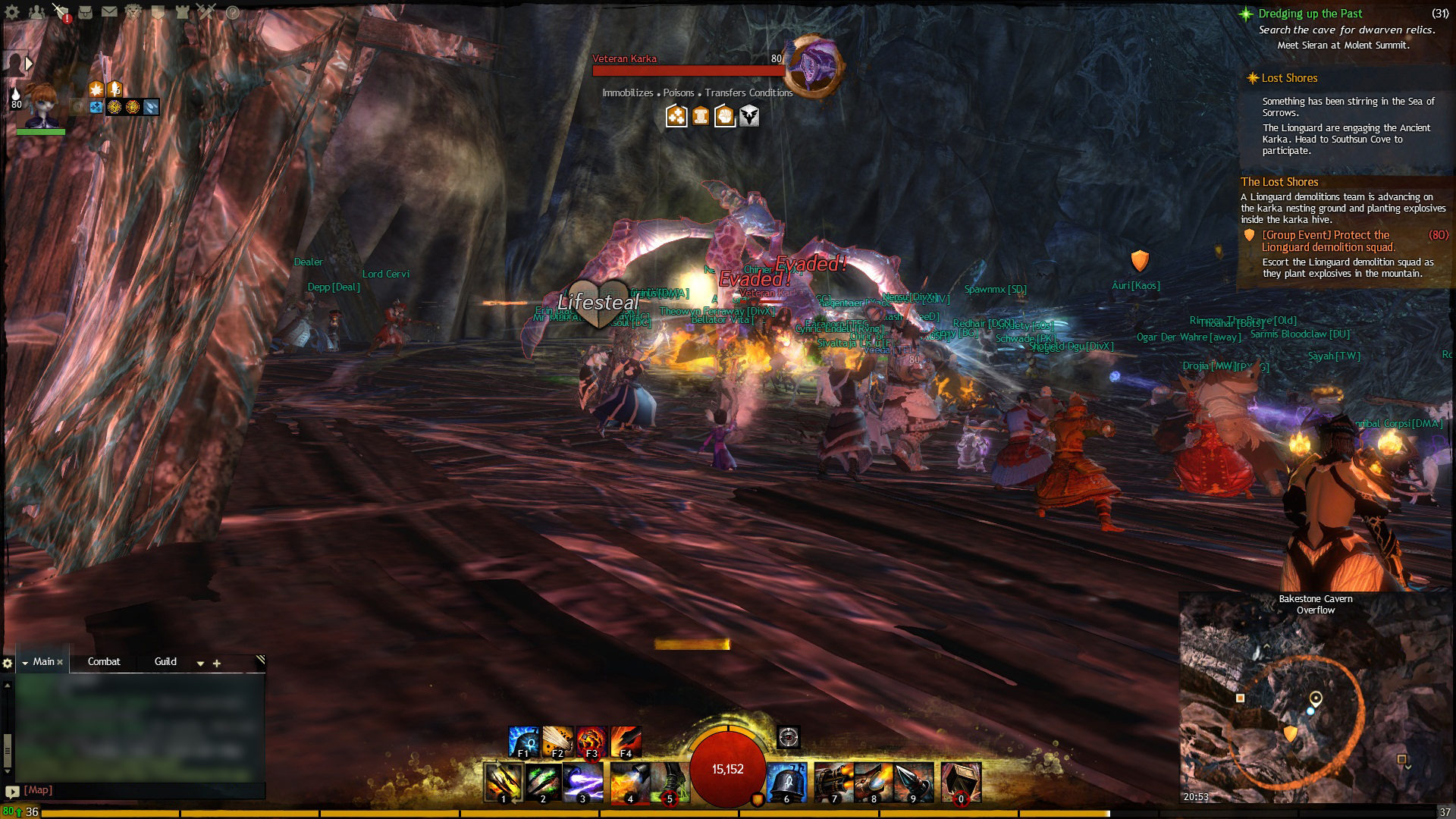
This weekend was jammed solid with choice for MMO gamers. SWTOR had just ushered in the mission chain to gain HK-51 as a companion droid. Trion launched RIFT: Storm Legion earlier this week. Planetside 2 wrapped up its open beta, while City of Steam started theirs. If you’re into online gaming, you were literally spoiled for choice this weekend.

And, of course, Guild Wars 2 started their much-vaunted Lost Shores Event, combining three days of nautical adventure with an open invitation to everyone with a friend already in the game.

It’s also been a weekend of bugs, as if some technophobic Midas has been creeping around server farms globally, disrupting code and torturing servers. No game has been completely error-free, but some have suffered more than others. And when games suffer, the gamers suffer with them.

Take Guild Wars 2 for example. Ignoring the small concern that the team eschew the notion of using public test servers, the Lost Shores event started with a small handful of bugs. Nothing major or crippling, unless you take into account the 24 hour limit to complete this initial phase. Arenanet subsequently relented on this, retaining some of the fixed quests into the second day.

Continue reading “On the Shores of Lag”

Gaming: The Journey to Service Saturation

Posted on May 29, 2012 by Gazimoff

I’m going to start with a bit of a history lesson.

Back when I was a kid, we used to go to the games store and buy a cassette tape. We’d take it home, play it into the machine, and wait half an hour to play the game we just bought. Sometimes it’d work, sometimes it wouldn’t. Sometimes it would randomly crash, or the last few levels would be impossible. We also had no internet, which meant no patches. We had a tape, to enjoy or not, as we chose.

Today’s gaming industry is radically different. Gamers are spending incredible amounts of time in multi-player games of one form or another. We’re consuming downloadable content to extend the lifespan of games we’ve bought. We’re using networks to interact with each other, from console variants such as Xbox Live, through to publisher or developer related ones such as Steam and Battle.net.

Games are becoming increasingly reliant on this back-end network to deliver significant parts of the experience. While this transition from Gaming as a Product to Gaming as a Service has benefits for both sides, what risks does it pose? How do we critically appraise a game that’s heavily reliant on these service components? What is the importance of reputation? And what happens when this service-based industry reaches saturation point?

Continue reading “Gaming: The Journey to Service Saturation”

Guild Wars 2: Spellcasters Quick Guide

Posted on March 17, 2012 by Gazimoff

If you’ve been reading this blog for a while you’ll probably notice that I have an ongoing love-affair with spellcasters in MMOs. Call it a mage, wizard or sorcerer – if it hurls magic then I’ll probably be playing it. Perhaps it’s because I identify with the thought of an intellectual magus studying to become proficient in arcane lore. Maybe I just have a primal desire to launch balls of fire from my hands. Who knows.

Earlier this week, ArenaNet announced that Pre-purchases of Guild Wars 2 will start on April 10th. As an added bonus everyone taking part also gets access to beta weekends. If you’re thinking of going for this MMO then I’d seriously suggest going for this deal, if only to get used to just how different this game is for spellcaster types.

As a result, I’ve gone through my notes from the closed beta back in February and pulled together this quick guide on spellcasters in Guild Wars 2, focusing on how they work, what the common features are and what sets them apart. I’ve also tried to explain how each profession feels in order to give you an idea of the playstyle. I’ve been a bit brief in some of my explanations, so if you have questions please let me know in the comments!

Continue reading “Guild Wars 2: Spellcasters Quick Guide”

Becoming The Nomad

Posted on February 10, 2012 by Gazimoff

My approach to MMOs is changing. I used to be someone who sticks to a game for several years, but now I consider changing every six months. It’s something I first felt back in August last year, and explored further when I thought there might be a limit on the number of subscription MMOs that could coexist. But is this change a natural thing that all MMO gamers go through, and is it healthy when MMOs are banking on years of subscription revenue to break even?

Back when I started playing World of Warcraft I made a promise to myself – this would be the game I would stick with until the servers were switched off. I was young, fresh and naive in the ways of MMO gaming. I honestly felt that this would be the game for me.

Since then there’s been a few distractions. Lord of the Rings Online, Age of Conan, and Aion have all managed to tempt me away for a few weeks, but it’s never been anything permanent. Even during my time in Rift there was an understanding that Warcraft was still my primary game.

Over the last six months my perspective has been changing. I’ve been shifting my stance from someone who has a primary game with an occasional dabble in a secondary title. Instead I’m becoming the MMO nomad, charting a route through the upcoming releases without any plans to stick to a particular title.

Continue reading “Becoming The Nomad”

Replacing the Superficial Intelligence

Posted on January 31, 2012 by Gazimoff

I have an opinion on Non-Player Characters. It emerged in the days of the first escort quest I attempted, when the computer-controlled NPC I’d be chaperoning would sprint ahead to certain death at the hands of hungry skeletons. If they weren’t sprinting ahead they’d probably stopped to admire a particularly intricate pebble and forgotten all about me. Either way you’re probably looking at death or failure, or more usually both.

At that point my opinion of NPCs was cemented: dumb as a bag of bricks.

Since that day we’ve had Warlocks and Hunters in World of Warcraft trying to order around pets and minions. Sometimes it works, sometimes it doesn’t. Spin the artificial intelligence roulette wheel and find out if your trusty sidekick is going to help or just stand there like a lemon. And although things have improved over the years, the lemon is still on that scoring board.

Continue reading “Replacing the Superficial Intelligence”

  • Previous
  • 1
  • 2
  • 3
  • 4
  • 5
  • …
  • 8
  • Next

Recent Posts

  • Discovering Palia
  • WildStar: The End
  • Final Fantasy XIV: Heavensward – The Latecomer Review
  • Blizzard Engineering – The Nuggets from Blizzcon 2018
  • Final Fantasy XIV: A Realm Reborn – The Latecomer Review

Recent Comments

  1. Wanderhoof on Final Fantasy XIV: A Realm Reborn – The Latecomer Review
  2. f2h on Final Fantasy XIV: A Realm Reborn – The Latecomer Review
  3. Peter Parker on Final Fantasy XIV: A Realm Reborn – The Latecomer Review
  4. Ami on Final Fantasy XIV: A Realm Reborn – The Latecomer Review
  5. Slesliat on Final Fantasy XIV: A Realm Reborn – The Latecomer Review

Archives

  • June 2021
  • November 2018
  • February 2018
  • January 2018
  • December 2017
  • November 2017
  • October 2017
  • August 2017
  • December 2016
  • September 2016
  • March 2016
  • January 2016
  • October 2015
  • September 2015
  • March 2015
  • October 2014
  • September 2014
  • August 2014
  • June 2014
  • February 2014
  • November 2013
  • October 2013
  • September 2013
  • August 2013
  • May 2013
  • November 2012
  • August 2012
  • July 2012
  • June 2012
  • May 2012
  • April 2012
  • March 2012
  • February 2012
  • January 2012
  • December 2011
  • November 2011
  • October 2011
  • September 2011
  • August 2011
  • July 2011
  • June 2011
  • May 2011
  • April 2011
  • March 2011
  • February 2011
  • January 2011
  • December 2010
  • November 2010
  • October 2010
  • September 2010
  • August 2010
  • July 2010
  • June 2010
  • May 2010
  • April 2010
  • March 2010

Categories

  • Final Fantasy XIV
  • General Gaming
  • Guest Posts
  • Guild Wars 2
  • Mage Mumblings
  • MMO Musings
  • Site Stuff
  • Star Wars: The Old Republic
  • Uncategorized
  • Warcraft
  • WildStar
© 2026 Mana Obscura | Powered by Minimalist Blog WordPress Theme