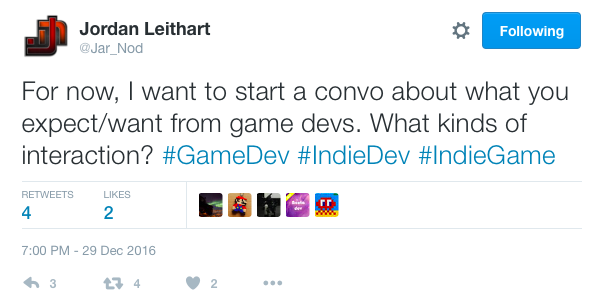
I’ll start with a disclaimer: although we’ve never met in person, I’ve known Leithart since 2012 when we were both fans of the then-upcoming MMO WildStar. Since those early days, he went into game development (coincidentally for the studio behind that same game), and I moved into game journalism. We still ping each other tweets from time to time, but that’s about it.
Getting on to the meat of the article, I wanted to respond to Leithart’s question above. As a small indie studio, with limited resources for marketing and PR, it’s only logical for the development team to want to do some of the heavy lifting themselves. It drums up interest in the game, provides direct feedback from potential players, and removes any reliance on the fickle foibles of the gaming press. Sounds like a win-win for spending a few minutes on Twitter, right?
Only, not really. While I’m a big fan of developers interacting with fans on social media, producing blog posts about their work and sharing unique insight, there’s also a risk that it gets in the way of actually developing the game. Tangentially, there’s also a risk that the game’s marketing voice – how it wants to be perceived by the gaming public – can get fragmented and/or diluted. And what happens if one of the developers goes off-brand? Can the incident be isolated without contaminating the game’s brand as a whole?
So, with both of these in mind, answering Leithart’s question is going to be tricky, particularly as I’m eager to make sure that both gamers and developers get something from being on social media. Luckily, there’s a bit of a cheat-sheet.